You’re an American citizen, born and bred in the United States, when your world is suddenly turned upside down. Your parents have one week to sell the family farm and dispose of all possessions except what they, your older brother, grandfather, and you can carry. You can’t even keep the family dog. No one knows where you’re going or for how long. When you finally arrive at Heart Mountain Relocation Camp in Wyoming, you’re met with dust, desolation, heat, and hastily constructed barracks. You’ve never seen so many Japanese in one place. Your life will never be the same.

The Pearl Harbor aftermath for Japanese Americans
After Japan bombed Pearl Harbor on December 7, 1941, action against Japanese Americans fell swiftly. After all, might they not be enemy spies and saboteurs?
Without any evidence of subversive activity, the FBI arrested Japanese Buddhist priests, judo instructors, journalists,and anyone else who might be considered a neighborhood or civic leader, thereby disrupting community life and sowing chaos and fear.

On February 19, 1942, President Franklin D. Roosevelt signed Executive Order 9066, which gave military commanders in five U.S. districts control over the fate of Japanese Americans living in their district. Only General John L. DeWitt, known for his prejudice against Japanese and in charge of the district encompassing California, Oregon, Washington, and Southern Arizona, chose to evacuate everyone of Japanese ancestry, basic civil rights be damned. He froze bank accounts tied to Japanese names, making it difficult to move elsewhere in the United States. Those who did manage to leave for inland states were often met with hostility, including signs that read “No Japs Wanted.”

Because West Coast Japanese Americans were given only a few days to dispose of their homes, farms, businesses, and possessions, most had to sell at ridiculously low prices. Others simply locked everything up, though there were no guarantees homes wouldn’t be vandalized or occupied by squatters (they often were). The evacuees were told to pack only what each person could carry, including bedding, personal hygiene items, clothing, and eating utensils. None of them knew had a clue what might happen next.

Enemies and Saboteurs
And who were these enemies and saboteurs? Many were Issei, “first generation” immigrants who had left Japan for a better life but were legally barred from becoming American citizens (in fact, Issei didn’t gain the right to naturalized citizenship until 1952). It included their American-born children (Nisei, or “second generation”) and grandchildren (Sansei, “third generation”), who were American citizens and had assimilated to American life. Even those with 1/16th Japanese blood–-that is, who had a Japanese great-grandparent-–were among the evacuees.
In fact, of the 120,000 people of Japanese descent who were forced from their homes and incarcerated without evidence or due process, about two-thirds of them were U.S. citizens. Although justification for the evacuation was to prevent espionage and sabotage, it included babies and children (even those in orphanages) and the elderly. According to this article on the National Park Service website, more than 17,000 children under 10 years of age, 2,000 seniors over 65 years old, and 1,000 handicapped or infirm persons were evacuated.
It was the largest single forced relocation in U.S. history.
If you’re not outraged, I don’t know what’s wrong with you.
“Assembly Centers”
Because evacuations occurred so quickly (the last Japanese Americans were in custody by June 1942), there was no place to put them. Instead, 15 makeshift detention facilities, known as “assembly centers,” were hastily thrown together, including fairgrounds, racetracks (where stalls served as living quarters), and new barracks.
Meanwhile, the government set about constructing 10 relocation centers, a euphemism for what might more accurately be called prison or concentration camps. They were located mostly in the middle of nowhere: Heart Mountain, WY (a WWII National Historic Landmark; details below), Manzanar, CA (now a National Historic Site with a museum, film, and a few reconstructed buildings), Minidoka, ID (also a National Historic Site, though little remains), Tule Lake, CA (a National Monument), and others in Arizona, Utah, Colorado, and Arkansas.

Heart Mountain Relocation Center
Although several detention centers today are open to visitors (Manzanar is probably the best known), Heart Mountain (see below) is especially poignant because its story is told by the Japanese Americans who lived there. An interpretive center outlines the chronology of events and internment, provides personal accounts of camp life, and stages special exhibits (it’s a Smithsonian Affiliate). The WWII National Historic Landmark also houses original structures, including barracks and a massive root cellar. Its location an hour east of Yellowstone National Park and 15 minutes from Cody (founded by “Buffalo Bill” Cody) makes it a convenient and worthwhile stop for visitors.

Constructing Heart Mountain Relocation Center in Wyoming
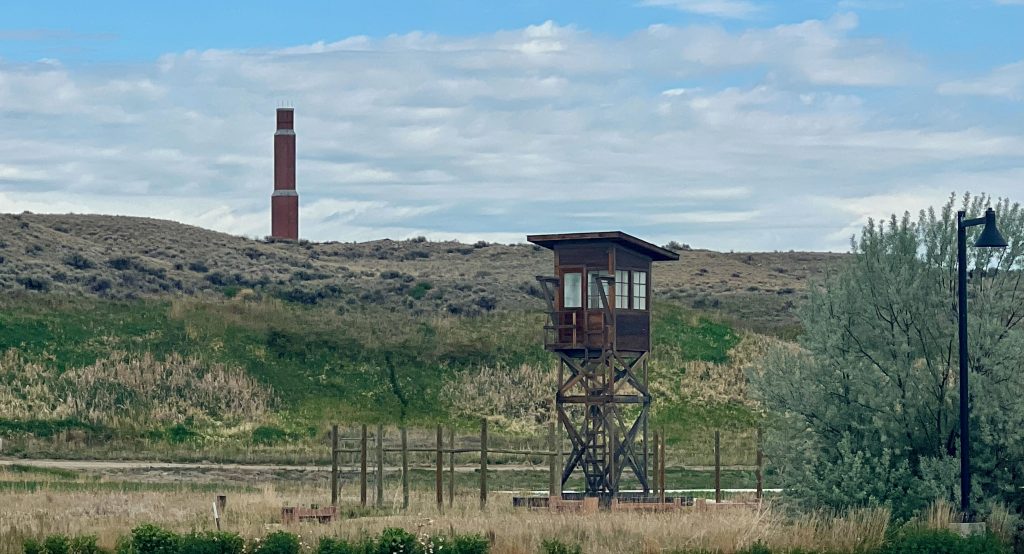
About 2,000 workers erected Heart Mountain’s 650 buildings in just six months. Spread over 740 arid acres owned by the Bureau of Reclamation, the camp contained administrative buildings, housing for guards and staff, a 150-bed hospital, mess halls, and communal bathrooms.
But mostly it was 467 barracks, arranged in 20 uniform blocks as though they were residential neighborhoods. Each block had 24 wooden barracks lined in rows, a communal mess hall, two latrine buildings (one for each gender, outfitted with toilets, showers, and laundry facilities), and two recreation halls.

The barracks, uninsulated and covered only with tarpaper, measured 20 feet wide and 120 feet long. Each barrack contained six one-room “apartments” ranging from 16 feet by 20 feet to 24 feet by 20 feet, the larger ones meant to hold up to six family members. Single people were placed with strangers.
The first trainload of alien enemies arrived on August 11, 1942, under the watchful eyes of armed guards.
Arriving at Heart Mountain Relocation Camp
After three months at an assembly center, you and your family finally board a train with other Japanese Americans for Heart Mountain Relocation Center. When you disembark, you are met with a lonely landscape of mostly sagebrush. How ugly, you think, compared to your farm in California. In the distance is a lone mountain, which you learn is named Heart Mountain. It seems like a cruel joke.

Armed guards lead you uphill to rows of barracks surrounded by barbed wire and nine guard towers. Even as a 12-year-old boy, you feel like a prisoner. It dawns on you that you might not be leaving any time soon.
Your mother lets out an involuntary cry when she steps inside your assigned new home, a single room bare except for one light fixture dangling from the ceiling, a potbelly stove, and military cots with two blankets for each occupant. There is no running water, kitchen, or bathroom. You can hear your new neighbors settling in on the other side of a thin partition extending only to where the nonexistent ceiling should be. Instead, it’s just open space up to the rafters. Privacy, it seems, will be non-existent.
Adjusting to your new life
Adjusting to your new life is difficult. Because barracks were hastily constructed with new, green wood, their walls keep shrinking, letting in dust, heat, or the cold. Although your mom does her best to block cracks with newspaper, your daily chores include sweeping up the dust and hauling water. When a trainload of Celotex arrives to line the walls and add a ceiling to your dwelling, it seems like you hit the jackpot. Still, it’s not enough to keep winter at bay. Because your family brought only California clothing, your meager savings must be used to buy coats and boots from the Sears Roebuck catalog.
But nothing helps when you have to go to the latrine on a bitterly cold night, which reaches -28°F in December 1942. The only consolation is that you might have more privacy; none of the toilets or showers have doors. Your mother does the math and figures more than 200 people share one latrine. For that reason, no matter the weather, your mother showers at night.
Heart Mountain, a city within a city
By January 1943, Heart Mountain Relocation Camp’s population reached 10,767, making it the third-largest city in Wyoming. For comparison, nearby Cody today has a population of about 10,000, except it spreads over 10 square miles. Heart Mountain’s incarcerated were crowded into one square mile.
Although there wasn’t much infrastructure when the first inmates arrived, they set to work improving living conditions. They fashioned furniture from fruit and shipping crates, scrap lumber, and other found materials and hung sheets to create “rooms” in their tiny homes. Eventually they added real furniture, hung curtains, and made their home as cozy as possible. Recreation halls became places of worship, general stores, dance halls, movie theaters, and space for communal activities.

In addition to the hospital, police and fire stations, the camp grew to include a garment factory, sawmill, cabinet shop, a newspaper distributed every Sunday, agricultural fields, and a new high school, complete with a gym/auditorium, library, economics room, machine shop, and woodshop.
Because relocation centers were meant to be self-sufficient, internees were the labor force for most activities and jobs, a must since families needed money to pay for clothing and necessities. Pay, however, was dismal: $12, $16, or $19 per month depending on the job.
The camp hospital, for example, which recorded 5,486 admissions and 391 major surgeries under the care of Japanese American physicians, nurses, nurse’s aides, dentists, pharmacists, and orderlies, paid incarcerated doctors just $19 a month. Caucasian nurses made $150 or more per month.
The Heart Mountain Root Cellar
Despite being surrounded by sagebrush, one of the most successful endeavors at Heart Mountain Relocation Center was its agricultural program. After completing a 5,000-foot canal as part of the Shoshone Irrigation Project in the spring of 1943, Japanese American internees cleared the sagebrush and planted several thousand acres of produce. Although local Wyoming farmers doubted success so late in the season, the first year yielded 1,065 tons of produce. The second year, 2,500 tons were harvested.
In fact, Heart Mountain was one of the highest-producing agricultural regions in the state, and some of its 45 different crops had never been planted. Peas, beans, carrots, cantaloupe, watermelon, potatoes, tomatoes, and other fruits and vegetables were harvested, including Japanese produce like daikon and napa cabbage.
All that produce, which fed not only Heart Mountain but was shipped to other relocation camps and nearby towns, needed a place for storage. Internees built that, too: two root cellars measuring 310 feet long and nearly 40 feet wide. The camp also raised hogs and chickens.

Settling in at Heart Mountain
Because your parents were farmers in California, their jobs entail working the fields. You rejoice that meals have come a long way since the rice and tomato sauce you were served when you first arrived.
But your parents aren’t happy about dining in communal mess hall, where fellow Japanese Americans cook and serve meals cafeteria-style, eaten communally at long tables. You prefer to dine with your school buddies, but your parents insist you sit with them for at least one meal a day. Your brother, on the other hand, is a senior in high school and gets to do what he wants. Later, you remember hardly any meals eaten together as a family. Only later do you think that must have made your mother sad.
Leisure activities
The other good thing to come out of that irrigation canal your dad helped build is the swimming hole! After about a year, guards left the watch towers–where were you going to go? Besides swimming, you love being in the Boy Scouts, which offers hiking, camping, making stuff, playing drums in the bugle corps, and leading the daily raising of the American flag and Pledge of Allegiance.
Your older brother used to be a Scout, but now he’s more interested in talking to girls, dance parties, the Camera Club, and listening to Bing Crosby records. His greatest joy is football, even though he’d never played before and doesn’t have the build to be a famous player, if you know what I mean. Still, the Heart Mountain Eagles high school team has lost only one game the past two years.

You feel most sorry for your grandfather, who doesn’t have much to do other than play goh all day long with the other Issei old-timers. It’s not lost on you that all the jobs and positions of importance in camp were given to Nisei, undermining what my dad says is the Japanese cultural reverence for elders. Grandfather says he’ll never get his life back; he’s too old to start over. Sometimes you think he’s shrinking by the day.
The Loyalty Oath and serving in the military
After Pearl Harbor, Japanese Americans became “enemy aliens” and were banned from military service. But in early 1943, the government changed its mind.
In February 1943, the War Relocation Authority, the government agency tasked with evacuating and incarcerating Japanese Americans, began issuing a mandatory questionnaire to all internees 18 years of age and older. Designed to test allegiance and recruit Nisei for military service, it contained two questions that proved vexing for many.
Question 27 asked whether male individuals would be willing to serve in the armed forces.
Question 28 asked whether the individual would swear unqualified allegiance to the United States and forswear allegiance to the Japanese emperor or any other foreign government.
In November 1943, a group of Nisei men at Heart Mountain formed the Fair Play Committee, which became the most successful legal and political resistance movement among the 10 relocation centers. Although willing to serve, their mission was simple: the restoration of rights as American citizens. After all, if they were loyal enough to fight for their country, why were they and their families detained behind barbed wire?
After Nisei began receiving draft notices in February 1944, the FPC issued this statement (on display at Heart Mountain): “We…are not afraid to go to war…We would gladly sacrifice our lives to protect and uphold the principles and ideals of our country…We feel the present program of drafting us from this concentration camp is unjust, unconstitutional, and against all principles of civilized usage…”

Families divided over the loyalty oath and military draft
When your brother turns 18 and receives a draft notice, he declares he won’t fight for a country that put us in a concentration camp. Your father is furious. Wouldn’t serving in the military prove loyalty to America?
Grandfather isn’t so sure. He’d fretted endlessly over the loyalty oath, especially question 28. Hadn’t the United States denied him natural citizenship based on race yet now demanded unqualified allegiance? If he renounced allegiance to the Japanese emperor, would his Japanese citizenship be revoked, leaving him stateless? In the end he answered yes, after hearing that those who answered no were sent to feared Tule Lake, the largest, most controversial relocation camp due to its high-security facility for Japanese-American dissidents.
When your brother refuses to report for his physical exam as a requirement for enlistment, he’s not the only one. He and sixty-two other draft resisters are ordered to stand trial at the federal courthouse in Cheyenne. Don’t worry, he tells you. The judge will see the insanity of drafting prisoners deprived of their basic rights. You cry when he leaves; your mother busies herself making origami flowers.
Imprisonment vs fighting the war
On June 12, 1944, in the largest mass trial in Wyoming history, all 63 Nisei were found guilty and sentenced to three years in prison. Even so, another 22 men from Heart Mountain subsequently resisted the draft and were also sentenced. Although President Harry S. Truman granted them a full pardon on Christmas Eve, 1947, most had already served their sentences.
Otherwise, more than 800 Heart Mountain residents served in the military. Most were members of the famous all-Japanese 442nd Regimental Combat Team, the most decorated unit in U.S. military history based on size and length of service. Up to 15 soldiers from Heart Mountain died (records vary), 52 were wounded, and two received the nation’s highest military award, the Medal of Honor. They were among the more than 33,000 Japanese Americans who served in the U.S. military in World War II.
Leaving Heart Mountain Relocation Center
On August 14, 1945, you’re overjoyed to hear on the radio that Japan surrendered. You pester your parents about what that means, but no one seems to know. Will your brother come home now? Where will you go? Will you still see the friends you’ve made over the past three years?
In November, your family is among the last to leave Heart Mountain Relocation Center. Just like three years before, you have to leave many things behind as you walk down the hill from the barracks, past soldiers with rifles and bayonets. Why are they there? Aren’t you finally free?
Everyone has been given $25 and a train ticket to anywhere they want. But you’ve heard stories. Wyoming passed laws preventing Japanese Americans from owning land or voting. And grandfather says there’s nothing left in California. He never wants to see it again.
In the end your parents choose Chicago, which they’d heard was receptive to Japanese Americans and where they hope you can get a fine education, find a good job, and be an outstanding American citizen.
Japanese internment a travesty
Although Japanese Americans were imprisoned because they were deemed potentially untrustworthy and disloyal, not one was ever charged with espionage or sabotage. By contrast, 18 Caucasians were tried for spying for Japan and at least 10 were convicted.
In 1988, President Ronald Reagan signed the Civil Liberties Act, which gave a formal apology and $20,000 in reparations to every surviving Japanese American who had been wrongly incarcerated during World War II. The Act acknowledged that no instances of espionage or sabotage had been documented and that the grave injustice had instead been motivated by “racial prejudice, wartime hysteria, and a failure of political leadership.”
Of course, no amount of money could compensate for what internees lost or what they’d endured.
Visiting Heart Mountain today
After Heart Mountain closed, the government opened the land to veteran homesteaders (Japanese Americans were excluded), who took advantage of the arable land and barracks that sold for just $1 a piece.
Although most Heart Mountain prisoners vowed never to return, some later became invested in educating the public about what had happened to them in the hope it would never happen again. Working with locals, they established a foundation to purchase 50 acres of the former camp and preserve rare original buildings. Heart Mountain became a national historic landmark in 2006; its Interpretative Center opened in 2011.
More recently, an original barrack that had been sold, moved, and used variously for meetings, storage, and a university field station, was returned to Heart Mountain. It’s here that I heard a presentation by Johnny Tim Yellowtail, historic site caretaker of Heart Mountain, who compared Japanese incarceration to the treatment of his Crow ancestors who were rounded up and placed in reservations and boarding schools.

Heart Mountain Interpretive Center
What makes the Heart Mountain Interpretive Center especially moving is that everything is presented in first person, making the experience intimate and immediate rather than something that happened long ago to strangers.
Many of the stories are heartbreaking–stories of loss, hardship, and perseverance. I created my fictional Heart Mountain family based on personal stories I read at the Interpretive Center and on its website. I also interviewed via Zoom 93-year-old Sam Mihara, who lived at Heart Mountain when he was 9 to 12 years old, became a rocket scientist at Boeing, and published a memoir about Heart Mountain called Blindsided.

“I had a lot of bad memories but also good,” Mihara told me. “I remember the barracks, the hospital, and the terrible schools because teachers were not certified. The region was originally Native American, so I enjoyed collecting arrowheads.”
Visits at Heart Mountain Interpretive Center start with a 15-minute documentary, “All We Could Carry,” told in first-person. Here are some quotes:
“All of a sudden I’m beginning to understand what racism is.”
“I saw the barbed wire fence around us and guard towers. And I thought, my god, this is a camp, a concentration camp.”
“When we went to the bathroom we had to sit next to strangers and do our personal business. It was shameful.”
“I don’t ever recall eating with my family.”
“We never complained or anything…I think people adapt to things and they quickly make it into a positive experience. That’s our strength. That’s one of the things about the Japanese spirit where you just endure. And that’s what we did.”
While a visit to Heart Mountain is both moving and educational, its website also provides in-depth access to personal experiences. Podcasts feature interviews and archival recordings on topics ranging from sports and leisure to organized resistance in the camp. Even children can enjoy the Heart Mountain Augmented Reality Experience, a free animation app depicting people enjoying the swimming hole, going to school, making traditional mochi, and other activities (I watched it on my computer).
Heart Mountain’s relevance today
It would be hard to overstate the role Heart Mountain plays in educating the public about shameful injustices law-abiding Japanese Americans suffered not so long ago.
Because they are not alone. Our country has a long history of hatred against “others,” against minorities, from Indigenous people to Blacks to Muslim Americans after 9/11. Today, our federal government arrests 50,000 immigrants every month, the majority of them without criminal record. What’s more, there’s no public information of where some of those those detainees are being held. Really, we can’t afford to forget.

For a story of immigration in this country, see my blog WHAT THE STATUE OF LIBERTY & ELLIS ISLAND TELL US ABOUT IMMIGRATION. For a parallel account of the “disappeared” during a dark side of military dictatorship, see my blog When Argentina Killed its Young.
Discover more from TravelReiber
Subscribe to get the latest posts sent to your email.