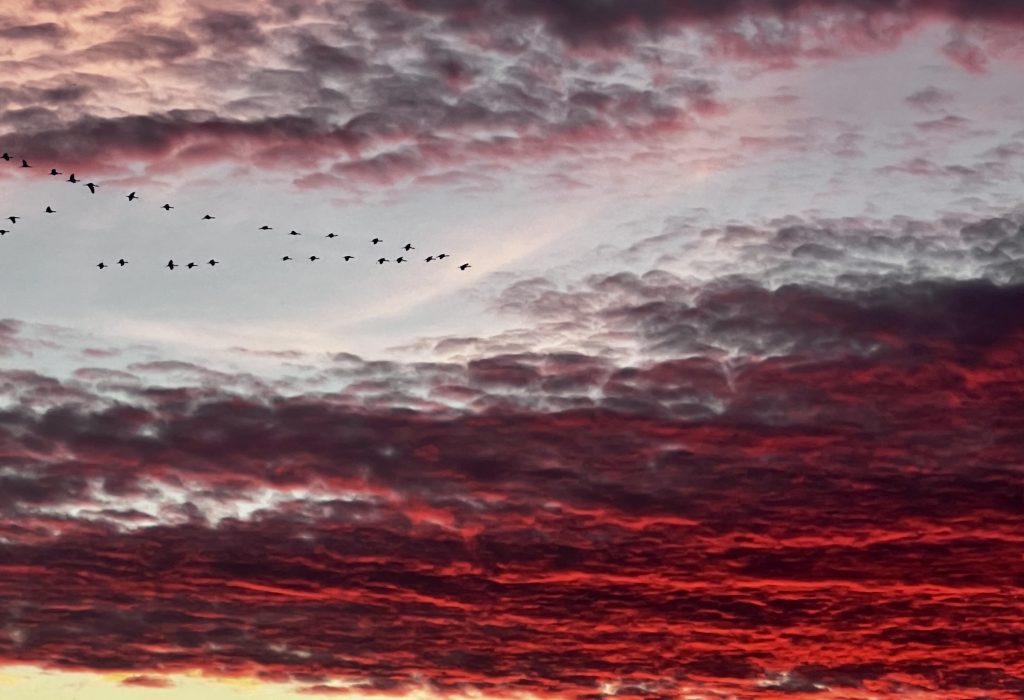
The stars were still out on a crisp March morning as we made our way to bird blinds on the banks of Nebraska’s Platte River. It was too dark to make out much of the sandhill cranes, but we sure could hear them. Gradually, dawn painted the monochrome landscape with broader strokes of color, and the muddled masses took shape as thousands of birds, stirring from their roosting sandbars in the river. We waited patiently and in awe, knowing we were about to bear witness to Nebraska’s annual sandhill crane migration, one of the greatest wildlife spectacles on earth.

What’s special about Nebraska’s sandhill crane migration
We were in Nebraska because every spring, sandhill cranes fly from their winter homes in northern Mexico, Texas, and other regions to summer nesting grounds in Canada, Alaska, and as far away as Siberia. It’s a long journey, up to 7,000 miles for some cranes, making Nebraska’s Platte River Valley a beloved stopover to rest and refuel.
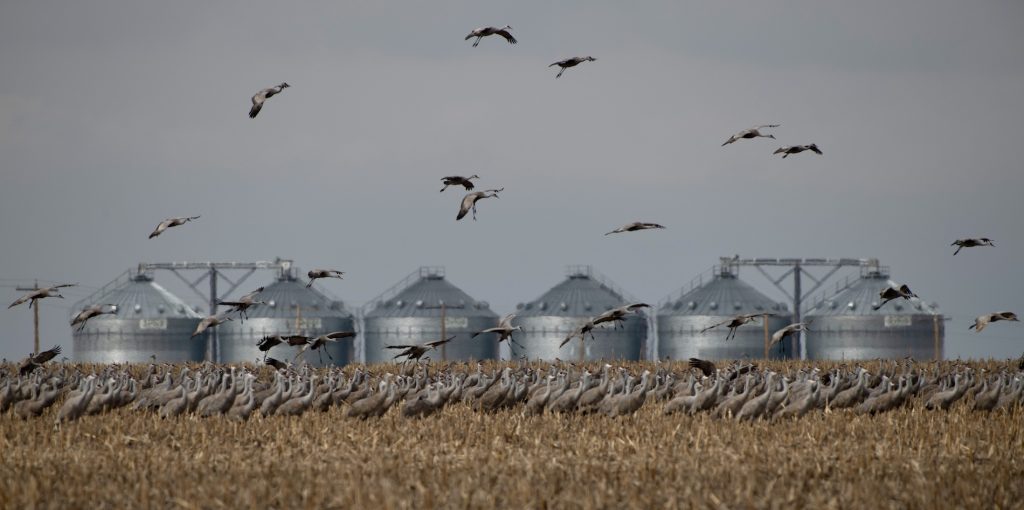
And we’re not talking about just a few hundred birds, or even a few thousand. Rather, up to a million sandhill cranes–approximately 80% of the world’s population–converge on the Platte River every spring, making it the largest gathering of cranes in the world. They’ve been doing it for thousands upon thousands of years.
The morning liftoff of thousands of sandhill cranes
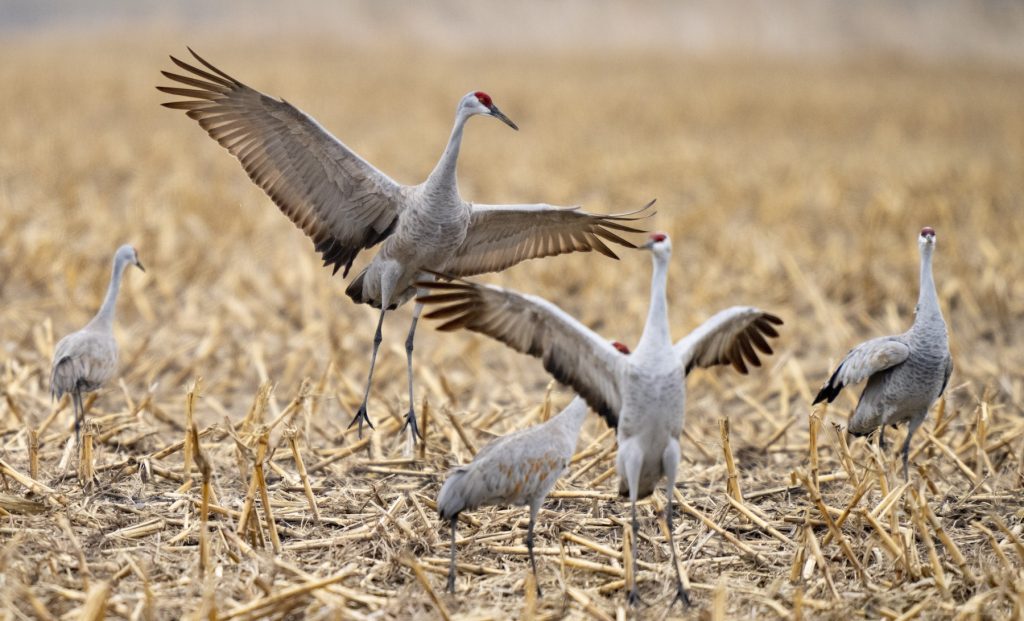
The sandhill cranes began their morning day as they probably always do, unaware of their star status and moving along the sandbars, wading through shallow waters, spreading and flapping their wings, and making a ruckus. It sounded like they were having the time of their lives, mates communicating with each other, parents with offspring, filling the air with a cacophony of honking, trumpeting, squeaking, bugling, and trilling. I later learned their calls can be heard up to 2.5 miles away.
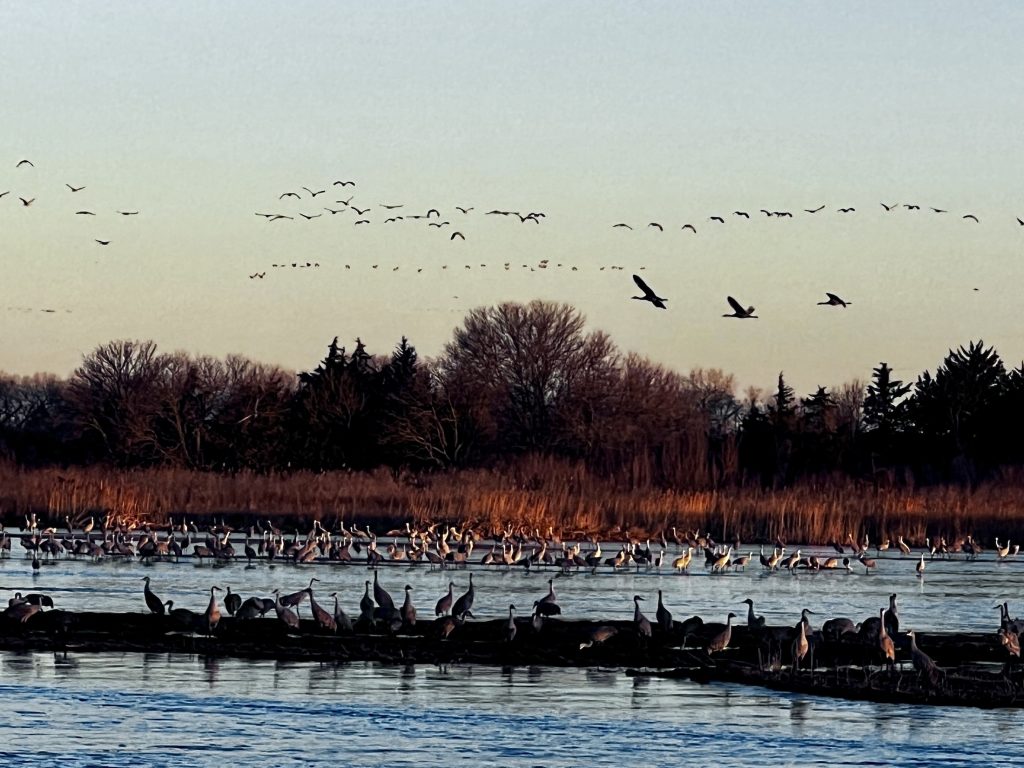
Clusters of trumpeting cranes were already lifting off before the sun’s rays hit the shores, up and down the river, over and over again. Then, finally, as though on cue, a cloud took to the air in a whir of wings and elongated bodies. Minutes later, more masses took to the sky in climactic exits. By the time the sun was fully up, the cranes were gone, off to feast in farmers’ stubble fields.
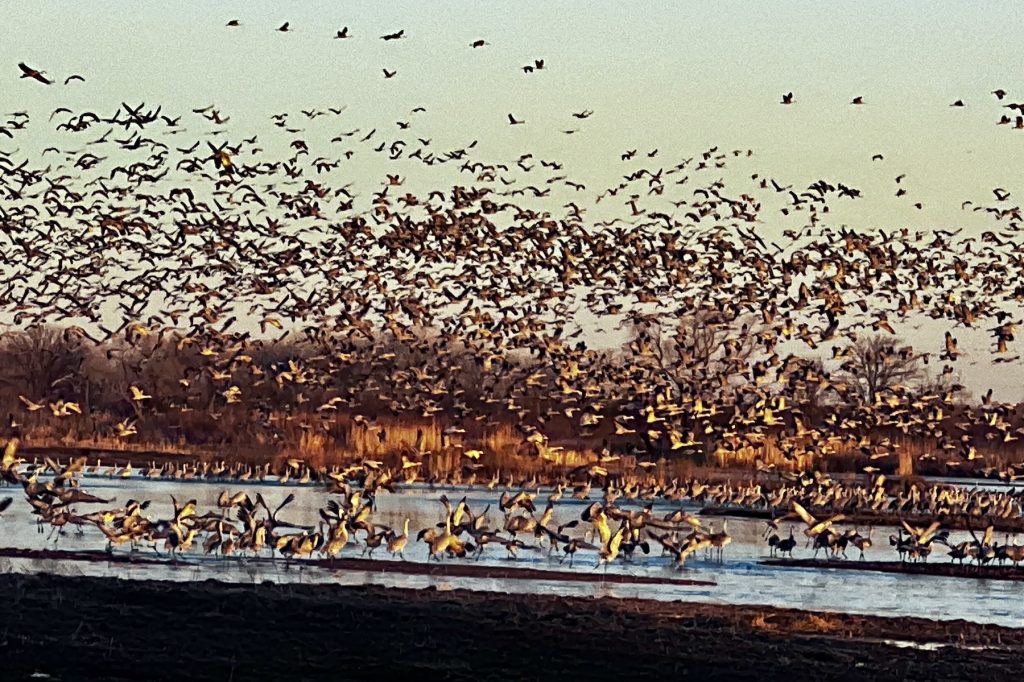
We spent 90 minutes in that blind at Rowe Sanctuary outside Kearney, all the while thankful to be present at one of North America’s greatest migrations. I took more than 270 photographs; I couldn’t help myself. Even so, there was plenty of time to put down the binoculars and take it all in. I wanted the feeling to stay with me for a lifetime.
“The magic of seeing the morning viewing is a way to connect with the awe and wonder of the natural world,” said Marcos Stoltzfus, director of the Iain Nicolson Audubon Center at Rowe Sanctuary. “Personally, my hope is that people can translate that awe into their backyard as something worth protecting and exploring.”
When to see Nebraska’s sandhill crane migration
“The cranes are here from Valentine’s Day to tax day [February 14 to April 15],” said Sarah Focke, director of Visit Kearney. “But the best viewing is from the beginning of March to mid-April, about six weeks.”
Viewings along the river take place twice daily: at dawn, when sandhill cranes take off from their overnight sandbar roosts, and at dusk, when they swoop back down and settle in. Sunrises can be more dramatic due to that climactic, massive liftoff, but you never know what will happen because, well, that’s the nature of nature. During the day, you can’t help but see them in surrounding fields fattening up for their journey north, because they’re everywhere.
The most comfortable place for river viewings of Nebraska’s sandhill crane migration is in one of the protected, coveted bird blinds, but note that you must act fast, because reservations fill quickly.
Rowe Sanctuary, where I went, offers dawn and dusk crane viewings from March 3 to April 6, 2027. Reservations for these blind-viewing experiences open January 7, 2027, and they often sell out immediately. Crane Trust is already accepting bookings for its protected bird-blind viewings. Another option is Dusty Trails, located near North Platte, which begins accepting reservations December 15 for its viewing blinds.
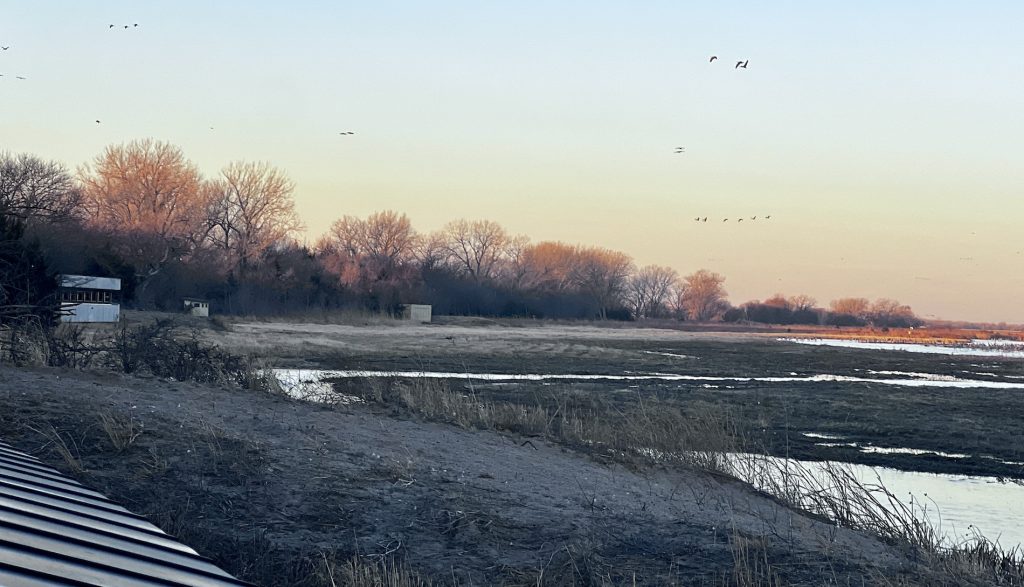
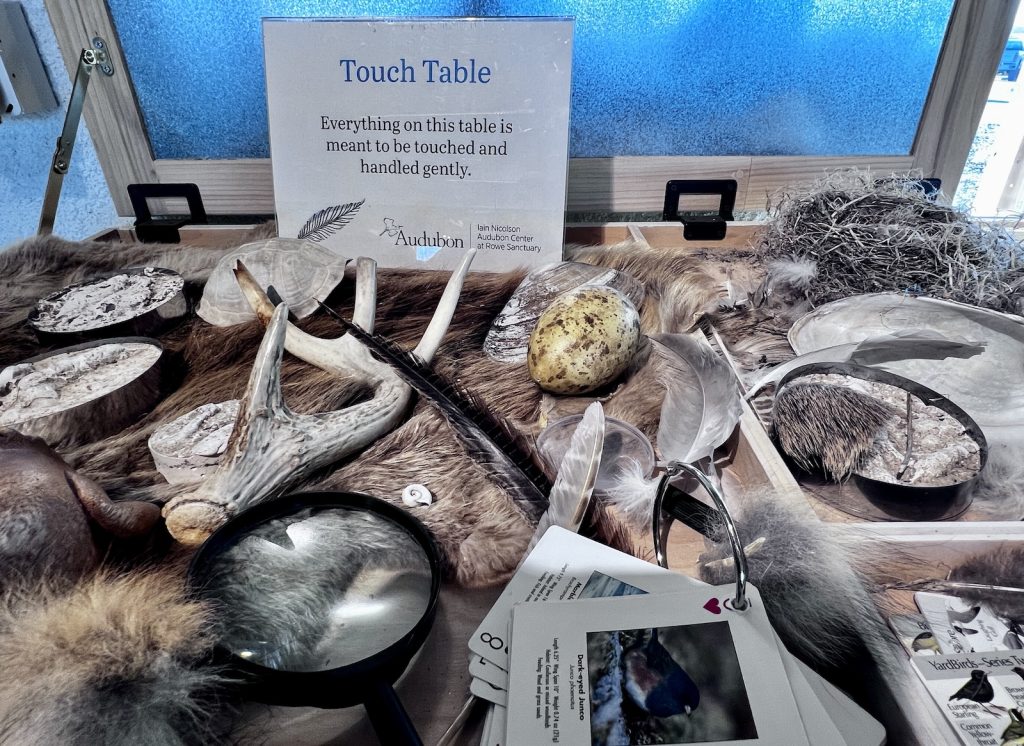
While all three private locations include knowledgeable guides to make your viewing experience more enjoyable, I also suggest dropping by one of the visitor centers located at Rowe Sanctuary and Crane Trust even if you haven’t booked a tour, because they contain so much information. Otherwise, there are also public viewing spots along the Platte River. More on that later.
Viewing etiquette for viewing Nebraska’s sandhill crane migration
Because most of the Platte River Valley, not to mention farmers’ fields, is on private land, be sure to stick to the sides of roads (where your car can serve as a blind) or to designated viewing sites. March is unpredictable but can be very cold, so be sure to dress in layers and bring a hat and gloves, not to mention binoculars. You should also wear dark clothing, and for goodness’ sake, do not use flash photography.
Flyover Country is for the birds
Believe it or not, I added Nebraska to my bucket list a couple of years back because of a TV advertisement that aired in my native Kansas, featuring hundreds of thousands of cranes converging on the Platte River Valley. Leaning into the notion that Nebraska is nothing but “flyover country,” a voiceover conceded that if people thought Nebraska was strictly for the birds, that was ok, because “honestly, it’s not for everyone.”
Even Stephen Colbert made fun of that ad (don’t you miss him?), but self-deprecating humor is something we Kansans appreciate. I was all in. But I didn’t manage to migrate up north to see the cranes until this year. That’s when I learned that not only is Nebraska not strictly for the birds (see my blog on Red Cloud, home to Willa Cather), but it fosters many other birds besides sandhill cranes.
Other migrating birds
More than 30 species of shorebirds and millions of ducks and geese migrate along with the sandhill cranes via the Central Flyway, a major North American bird migration route stretching north-south through the Great Plains.
One of the more exciting birds to pass through Nebraska, in my opinion, is the whooping crane. One of the largest and most endangered cranes in the world, they don’t garner nearly the attention sandhill cranes get, though they should. Almost extinct in the United States in 1941, heroic conservation measures have increased numbers to about 700 in the wild today. More than 550 whooping cranes pass through Nebraska in spring and autumn on their 2,400-mile migration between the central Texas coast and Wood Buffalo National Park in central Canada. That alone is worth celebrating.
Of course, there are also plenty of birds who like Nebraska so much they stick around, like trumpeter swans. But while I came for the elegant sandhill cranes and their migration story, it was the antics of the male greater prairie-chicken that stole my heart.
Sandhill cranes 101
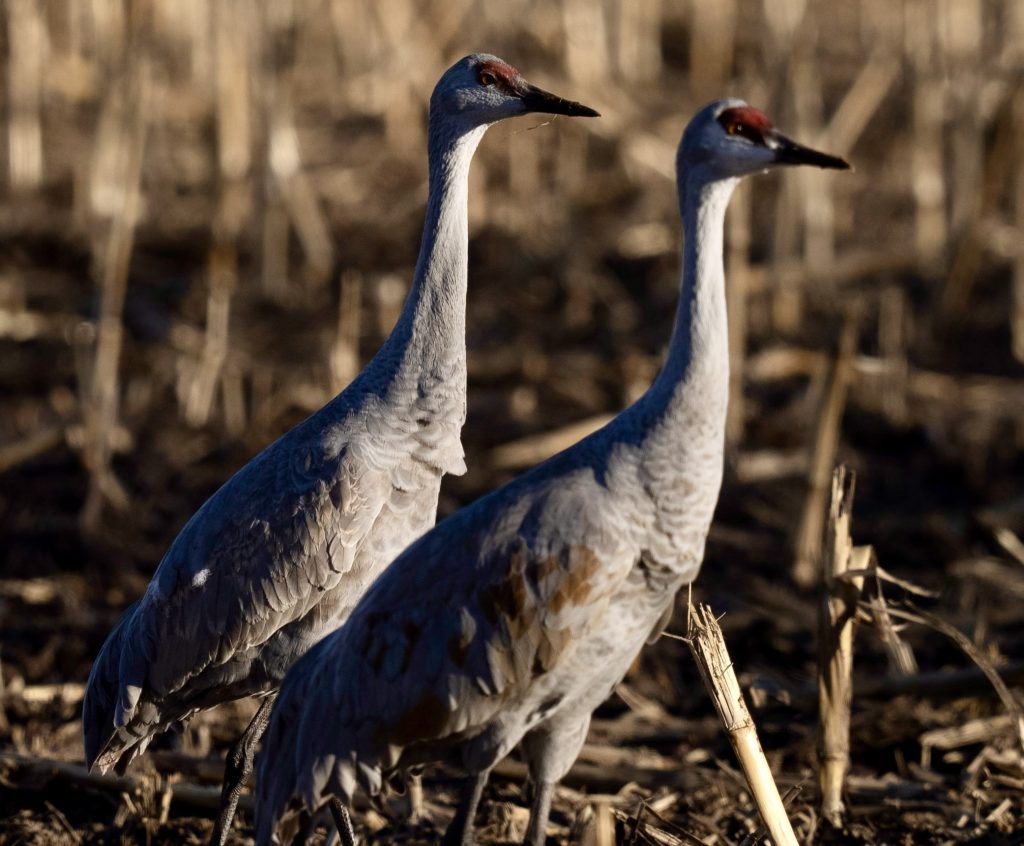
On average, a sandhill crane stands about three to four feet tall and weighs only eight to 10 pounds. With a wingspan of more than six feet, they fly 30 to 50 miles per hour during migration and cover about 350 miles per day.
The sexes look the same. To my eye, their coloring is unremarkable–a kind of grayish-brownish-white–but maybe that’s because I’m not a mare (female crane) nor a roan (male crane). But when they’re excited, a patch of skin on the top of their head expands into a remarkable red crown. This, along with facial expressions like opening and closing their beaks and those various trumpeting and bugling calls, makes sandhill cranes masters of communication.
Maybe that’s why sandhill cranes manage to stay together for life, despite living a long 25 years. Or maybe it’s because the guys step up and do their part, helping to build nests and incubate the typical one or two eggs. Baby chicks are sometimes referred to as colts, because of their ability to run off and swim the day they’re born (to me it sounds like a parenting nightmare).
You won’t see sandhill cranes mating in Nebraska–for that you must travel to their northern nesting grounds. But you will see offspring because juveniles stay with their parents for about 10 months and accompany them on their first migration. That’s one of the reasons they’re so noisy when waking up at the crack of dawn: all those families keeping track of each other, surrounded by thousands of birds. I try to imagine humans in a similar situation; I cannot.
Where to see Nebraska’s sandhill crane migration
North America’s Central Flyway narrows in on about 150 miles of the Platte River Valley, from the city of North Platte in the west to Grand Island in the East, with Kearney in between. What makes this migration path so convenient and accessible to birdwatchers is that it pretty much parallels Interstate-80 across the state, offering plenty of opportunities to see the million or so sandhill cranes that pass through (numbers vary from about 600,000 to one million cranes). In fact, I spotted my first sandhill cranes while driving on I-80 about 25 miles east of Kearney as they dined in farmers’ fields.
For a map of viewing spots along the Platte River, download this Nebraska Flyway brochure.
Kearney in the middle of Sandhill Crane country
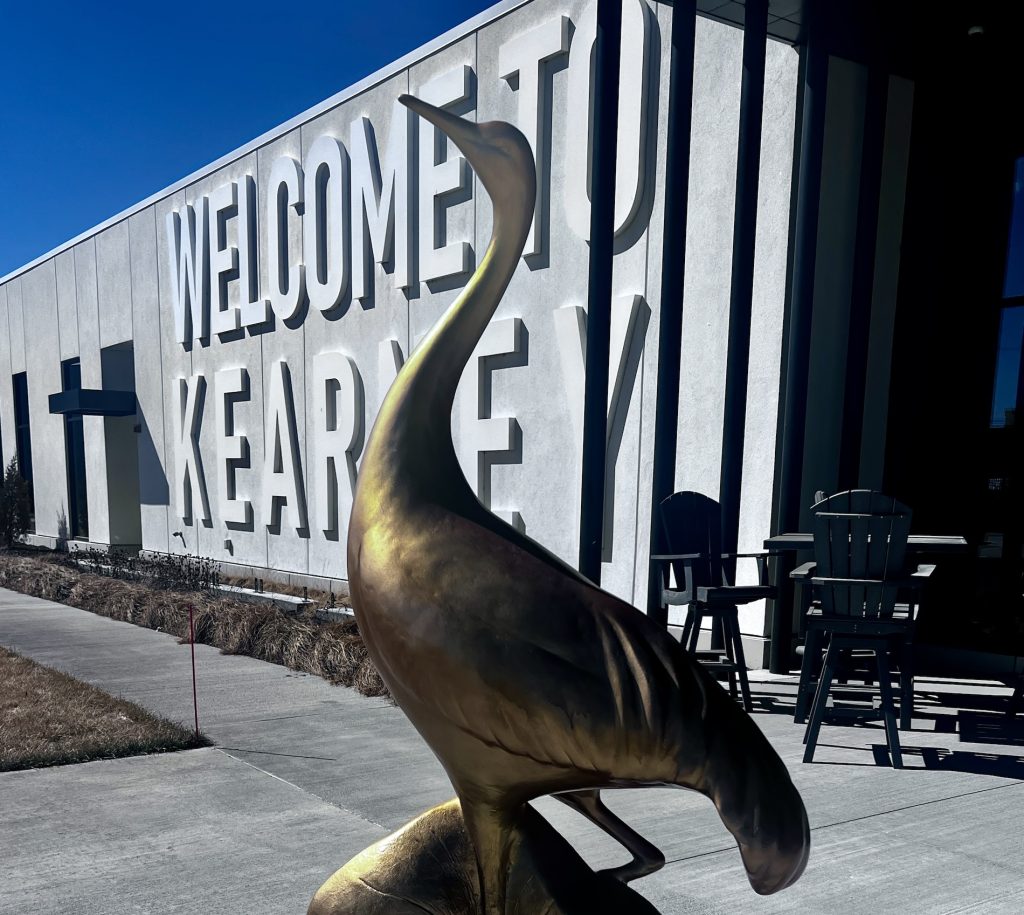
Kearney, population 35,000, shows some of that self-deprecating Nebraskan humor right off by declaring at the top of its Visit Kearney website what everyone wants to know: how to pronounce it (car+knee).
It then goes on to proclaim itself “The Sandhill Crane Capital of the World,” which probably leaves some neighbors a bit envious, probably because they didn’t think of it first; Kearney has published a crane brochure for 30 years.
“People come from all over to see the cranes,” said Focke, the director at Visit Kearney. “We’ve had people from 30 to 40 countries and from all the states.”
Kearney offers the most opportunities for public viewings, making it a good place to base yourself. It also offers some worthwhile diversions for when you’re all craned out. The Museum of Nebraska Art is a good place to start, as is the Archway, an immersive museum that tells the story of people traveling along the Great Platte River Road via the Oregon, California, and Mormon trails, the Pony Express, Overland Stagecoach, and First Transcontinental Railroad.
Iain Nicolson Audubon Center at Rowe Sanctuary
Twenty minutes from Kearney, Rowe Sanctuary is the old-timer among sandhill crane viewing grounds, established in 1974 as one of the most pristine crane habitats along the Platte River. It has since grown from 440 acres to 3,000 acres and includes the Iain Nicolson Audubon Center, open all year and offering nature exhibits that make a stopover worthwhile even if you can’t snag one of the coveted blind spots. With 15 miles of hiking trails, it’s a good place to see many other migrating birds, like whooping cranes.
Public viewing areas near Kearney
There’s a bridge over the Platte River at the Fort Kearney State Recreation Area, popular with birders at sunset for views of cranes flying overhead as they travel from nearby fields to roost on sandbars (a daily state park permit required). We didn’t get massive amounts of sandhill cranes on the evening I was there, but the sunset was spectacular. The bridge also draws visitors at dawn. Another popular spot for river viewing is the Plautz Viewing Platform near Rowe Sanctuary.

Although they’re not near the river, daytime viewing spots overlook places where sandhill cranes feed. Waste corn left on farmers’ fields after harvest is a beloved crane food (if you’ve ever driven through Nebraska, you know why it’s called the Cornhusker State). They’ll also snag insects, snails, lizards, and other delectables on fields and wet meadows. During their gourmet stopover in Nebraska, sandhill cranes will gain about 15% of their body weight before the long slog north.
Other viewing places along the Platte River Valley
About 100 miles west of Kearney is North Platte, home to two free public viewing locations and Dusty Trails, which offers viewing tours for both sandhill cranes and prairie chickens.
At the opposite end of the Nebraska Flyway is Grand Island, where you’ll find the nearby Crane Trust, also with riverfront blinds for sunrise and sunset tours, nature trails, and the excellent Nature & Visitor Center.
What about the future for Nebraska’s sandhill crane migration?
The Platte River is the perfect place for migrating sandhill cranes. The river gets its name from French explorers, who called it “plat,” meaning flat river. The Otoe Native Americans called it “Nebraskier” in reference to the river’s calmness.
The flat, calm Platte River, fed by snowmelt from the Rocky Mountains, is laced with shallow, braided channels and plenty of sandbars, the perfect nighttime roost for keeping predators like coyotes at bay.
But whereas the Platte River used to be up to three miles across and one to six feet deep, bordered by large swaths of native grasslands and wet meadows, mankind has taken its toll.
Platte River not what it used to be
At the Iain Nicolson Audubon Center at Rowe Sanctuary, I learned that active channels are only a tenth as wide as they used to be. A sliding panel showed me what the area looked like in the 1860s and then in the 1930s, including a narrower river and grasslands reduced by half. Another panel showed that by the 1980s, grasslands had been reduced by half again, and the river was thousands of feet narrower.
In other words, because of dams built for irrigation, hydropower, water consumption, and flood control, 70% of the river’s flow is now gone before it even reaches Rowe. Lower flow means more sediment and vegetation growing on sandbars. The groundwater table is sinking, and the Platte Valley’s wet meadows, of which only 10% remain, are drying up. None of these things are good for cranes.
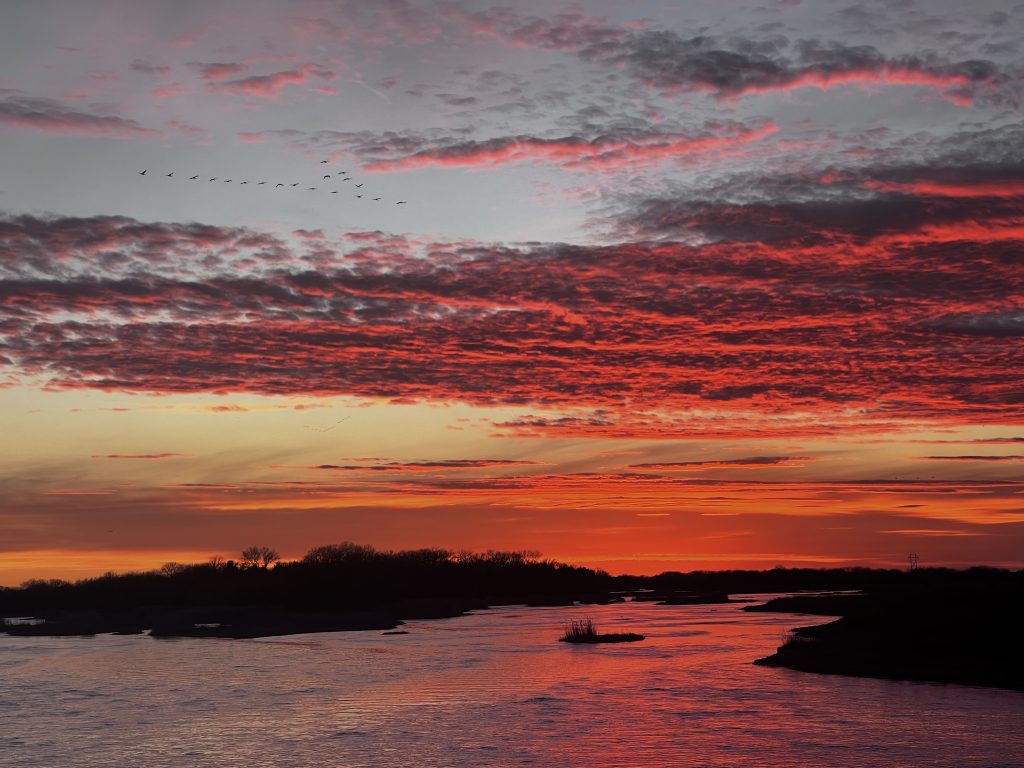
According to Stoltzfus, the number one challenge at Rowe Sanctuary was managing the river channel to ensure there was enough water to maintain sandbars and a braided river and to prevent the buildup of more islands and plants.
“Climate change is a threat to birds existentially,” says Stoltzfus. “Study predicts there will be an earlier spring. It’s already starting to shift, which affects species adapted to a specific habitat. If the ecosystem changes, birds have to adapt. Some might have to move.”
That being said, sandhill cranes are a success story and in the last few decades have greatly expanded their nesting range and numbers. That doesn’t mean that they aren’t vulnerable to future habitat loss and other developments, but their popularity might help save them.
Economic impact of Nebraska’s sandhill crane migration
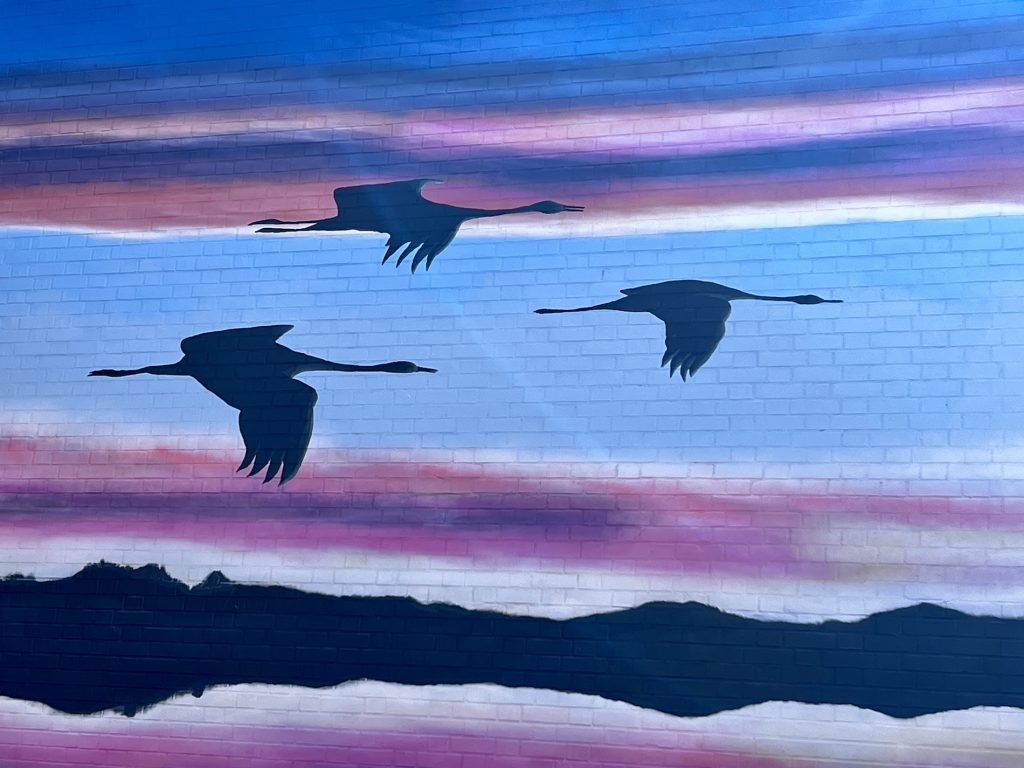
According to a University of Nebraska study on the effects of spring wildlife migration in Central Nebraska, the economic impact of visitors in $28 million in 2025, compared to $14 million in 2017. Most visitors stayed 3.1 days, and 98% came for the annual migration.
[A mural in downtown Kearney. Photo by Beth Reiber]
In other words, sandhill cranes are paying for their room and board in Nebraska by attracting people like me.
Greater Prairie-chicken viewing is a bonus
I was so focused on Nebraska’s sandhill crane migration, I didn’t know I could also see Greater Prairie-chickens. That meant I didn’t have a reservation. But as sometimes happens, there was a last-minute cancellation at Prairie Wind Birding Tours, and I was in.
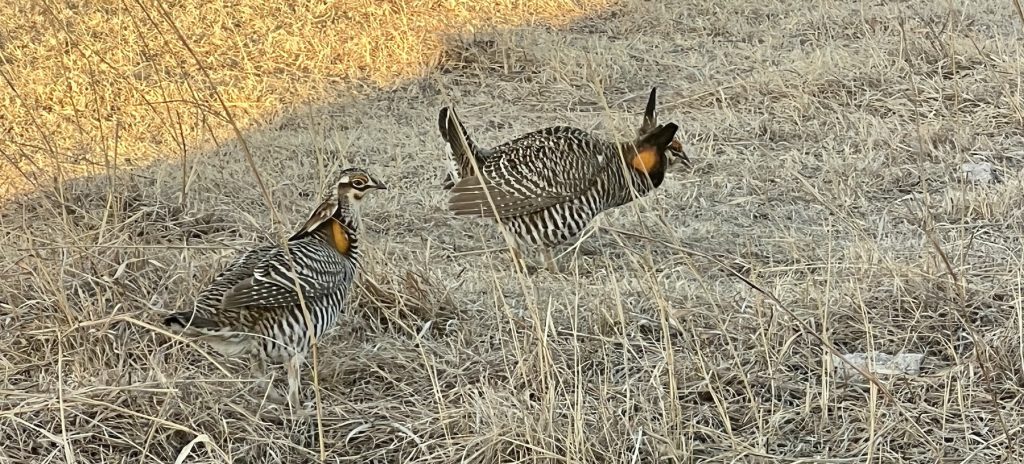
The viewing drill is the same as with the cranes: get there in the dark and wait until daybreak for the action to begin. What sets this experience apart, however, is that you’re actually driving to Robyn and Kent Hubbert’s rural home about 15 minutes west of Kearney before being taken to blinds on their property. Afterwards, you’re invited into the Hubberts’ living room for coffee and rolls. You couldn’t ask for a more down-home experience. Visitors love it.
“This year we had 550 guests,” said Robyn as we waited in their living room for everyone to show up. “Meeting in our home is part of our charm. Yesterday we had guests from Mongolia. People come from the East Coast, from the West Coast. Amy Tan was here Monday.”
Reservations open December 15, 2026, for tours from March 8 to April 10, 2027. Otherwise, other chicken-viewing options include Dusty Trails, 100 miles west of Kearney near North Platte, and Prairie Chicken Dance Tours, a two-hour drive from Kearney (note that this one requires a one-hour orientation the night before).
The gathering of the male prairie chickens
The place where male prairie chickens gather for their elaborate mating rituals is called a lek, which Robyn said comes from Swedish, meaning “to play or be playful”; in other words, courting grounds. Greater Prairie-chickens don’t migrate, so they’re in places like Nebraska and Kansas year-round. Their courting rituals take place mainly in March and April; mating takes place in April.
“This property belonged 100 years ago to Kent’s great-grandfather, and there’s been a lek here probably all that time,” said Robyn. “A successful lek has short grass, plus some tall grass for resting, but not a lot of overhead like trees, which will attract hawks, owls and other predators. It used to be a buffalo wallow. Now it’s a prairie dog town.”
Yep, we saw prairie dogs, too. Double bonus.

Dancing, stomping, and booming by male prairie chickens
It was barely light when we arrived at our blind, but the males were already there, waiting for the ladies to arrive. That’s right. Whereas males tend to return to the same lek from one year to the next (they generally live two to three years), females travel to multiple leks in one day, scouting out prospective males and their leks. Some days they don’t come at all.
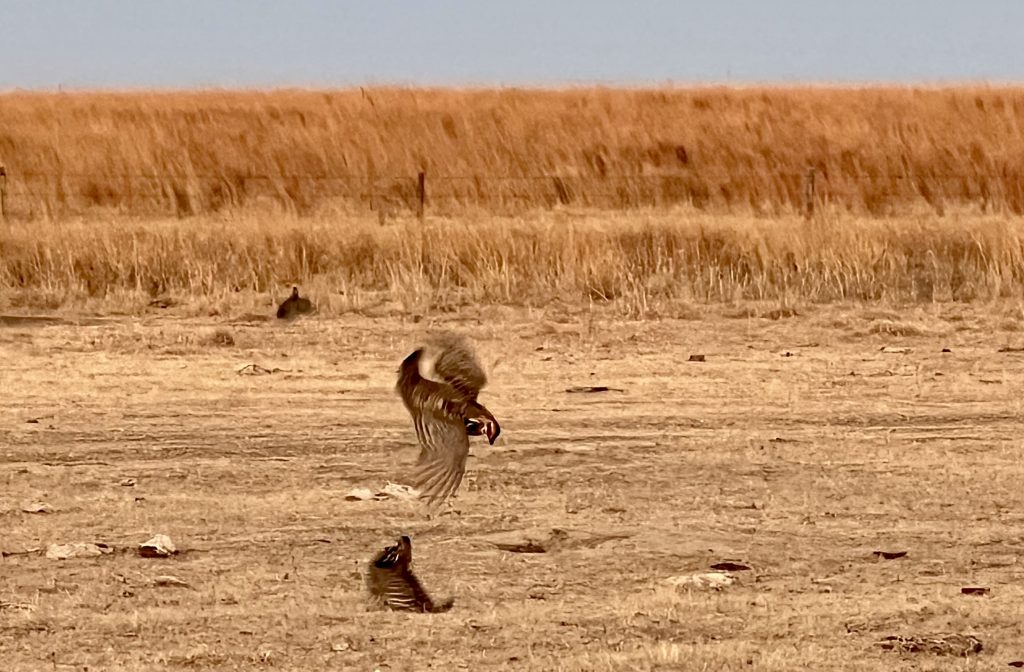
But a handful of hens flew in while we were there, and that’s when it got interesting. Males started strutting their stuff, rotating in a half-circle one way and then the other, raising their neck feathers, furiously stomping their feet in quick succession like a toddler’s tantrum, jumping into the air, and making runs at each other. [Beth Reiber photo]
The most impressive sight was when the males inflated brightly colored air sacs on their throats, crouched down, and popped their tail feathers, letting loose a loud boom that can be heard a mile away.

It’s all meant to attract females, but alas. It apparently doesn’t matter how much effort a male puts out. Each male stakes a small area of the lek as his own, with the most dominant males in the middle and subordinate birds shunted to the sidelines. As luck would have it, most hens prefer to mate with dominant males, who score 90% of the pairings in their lek. Better luck next year, I suppose.
An unexpected sighting
During my three days in and around Kearney, I saw not only sandhill cranes and prairie chickens but also the Western meadowlark (Nebraska’s state bird) and the usual suspects like geese, ducks, turkeys, hawks, and deer.
And so it seemed almost quaint when in downtown Kearney I saw a young girl excitedly point to the sky and exclaim, “Look, Mom! A vulture!”
I guess it’s all relative.